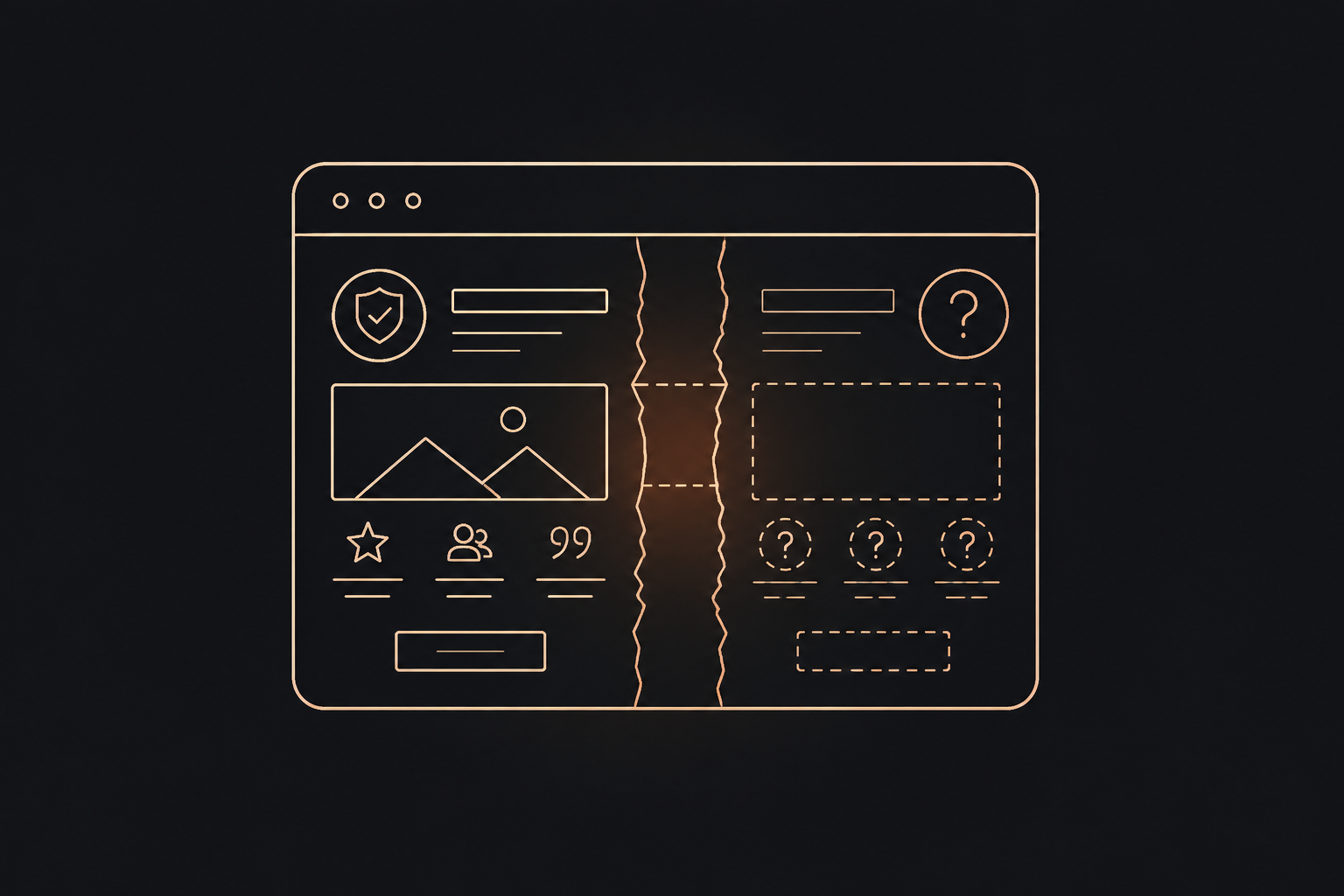
Your product closes deals in demo calls. Your sales team gets it. Your existing clients get it. But somewhere between a prospect Googling you and picking up the phone, something breaks. They arrive at your site, form an impression in under ten seconds, and quietly move on. Not because your product failed them — because your website did. That's the credibility gap: the distance between how good your business actually is and how good your website makes it look.
Why Does a Credibility Gap Website Happen?
The easy explanation is that the site looks dated or needs a refresh. That's the shallow read. The real cause is structural: the site was built to describe the product, not to position the business. There's a difference. Description tells visitors what the product does. Positioning tells them what kind of company they're dealing with — the level of thinking behind it, the clients it serves, the outcomes it delivers. When a site only describes, it reads like a brochure. When it positions, it reads like a peer. B2B buyers — especially at the enterprise or high-ticket level — make a credibility judgment before they ever evaluate features. If the site doesn't pass that judgment, the features never get considered.
This is why the credibility gap isn't a design problem, strictly speaking. It's a perception problem that design either solves or reinforces. Fixing it isn't about adding animations or swapping the color palette. It's about restructuring what the site communicates and in what order.
How Do You Know If Your Site Has It?
There's a simple diagnostic. Ask yourself: if a well-funded competitor in your space landed on your site without knowing who you were, would they take you seriously as a peer? Not as a vendor — as a peer. Vendors get evaluated on price. Peers get evaluated on fit and trust. The gap shows up in specific, observable ways: a hero section that leads with features instead of business outcomes; social proof buried at the bottom rather than anchoring the top; visual inconsistency that signals a site assembled over time rather than designed with intent; copy that explains the product category rather than the buyer's problem. Any one of these creates friction. Together, they signal an early-stage or underfunded operation — regardless of what's actually true about the business.
The business consequence isn't just a lower conversion rate. It's shorter, lower-quality sales conversations — because the prospect arrives unprimed, skeptical, or already half-decided against you. Your sales team ends up doing credibility work that the website should have done in advance.
The Fix Is Hierarchy, Not Aesthetics
Closing a credibility gap website requires one core intervention: restructuring the information hierarchy so the most trust-building content appears first, and the most detailed product content appears later. Buyers don't read sites sequentially — they scan, and they make a gut decision fast. The job of the first screen is to earn the next ten seconds of attention. That means leading with a clear articulation of the business outcome you deliver, reinforced immediately by the caliber of clients or logos you've worked with, and supported by a visual language that signals the same level of sophistication as the product itself. Every subsequent section should deepen confidence in that first impression, not introduce new claims that contradict it.
This is what we diagnose in the strategy phase before any design work begins. Not which fonts to use, but what the site needs to say, and what it needs to say first. Hierarchy is the map to the sale — get it wrong, and even a visually polished site will underperform.
What Closing the Gap Actually Looks Like
Kendra Dancy, founder of UpwardFi, came in with a real business and a brand presentation that wasn't keeping pace with it. The rebrand and Framer build we delivered restructured both the visual identity and the site's communication logic — leading with outcomes, anchoring trust early, and creating a clear path toward the pricing packages that mattered most to her business. Her own words on the result: "The design-to-build work in Framer was smooth and thoughtful, and the final site strikes exactly the balance I was hoping for." That balance — between approachable and authoritative, between clear and sophisticated — is exactly what closing a credibility gap feels like in practice.
Ready to Close Your Credibility Gap?
If your product is strong but your site isn't pulling its weight in the sales process, the problem is diagnosable and fixable. We start with strategy — not pixels — to figure out exactly where the perception breaks down and what it takes to close it. From there, I handle design and build end-to-end, so you're not managing a scattered team of vendors.
Book a 30-minute call and we'll look at your site together. If you'd rather start with a quick question first, email Ivan directly.